Missed Your Focus Goal? What to Do When You Miss a Productivity Goal
Here's what to do when you miss a productivity goal: run a five-minute debrief, find the real cause, forgive the miss in one sentence, and set a smaller goal for the next session. That's it. The long replay of everything you did wrong isn't part of the method.
The timer rings. You planned to finish slides 4 to 8. You're on slide 5. And the voice starts: you always do this.
A missed goal is data. The story you tell about it is a choice.
Why missing a goal is normal
You're not unusually bad at planning. Everyone is. Psychologists Roger Buehler, Dale Griffin and Michael Ross called it the planning fallacy: people underestimate how long their own tasks will take, even when they know similar tasks ran late before. In one of their studies, most students finished their thesis later than they predicted.
So a missed goal usually means the goal was too big for the time. That's a sizing problem, not a character problem.
Why beating yourself up makes the next session worse
Guilt feels like taking responsibility. It works against you:
- In a study of university students, those who forgave themselves for procrastinating on their first exam procrastinated less before the next one.
- In experiments by Juliana Breines and Serena Chen, people who treated a failure with self-compassion were more motivated to improve, and studied longer for a retest.
Being kind to yourself isn't letting yourself off the hook. It's what gets you back to the desk.
What to do when you miss a productivity goal: the 5-minute debrief
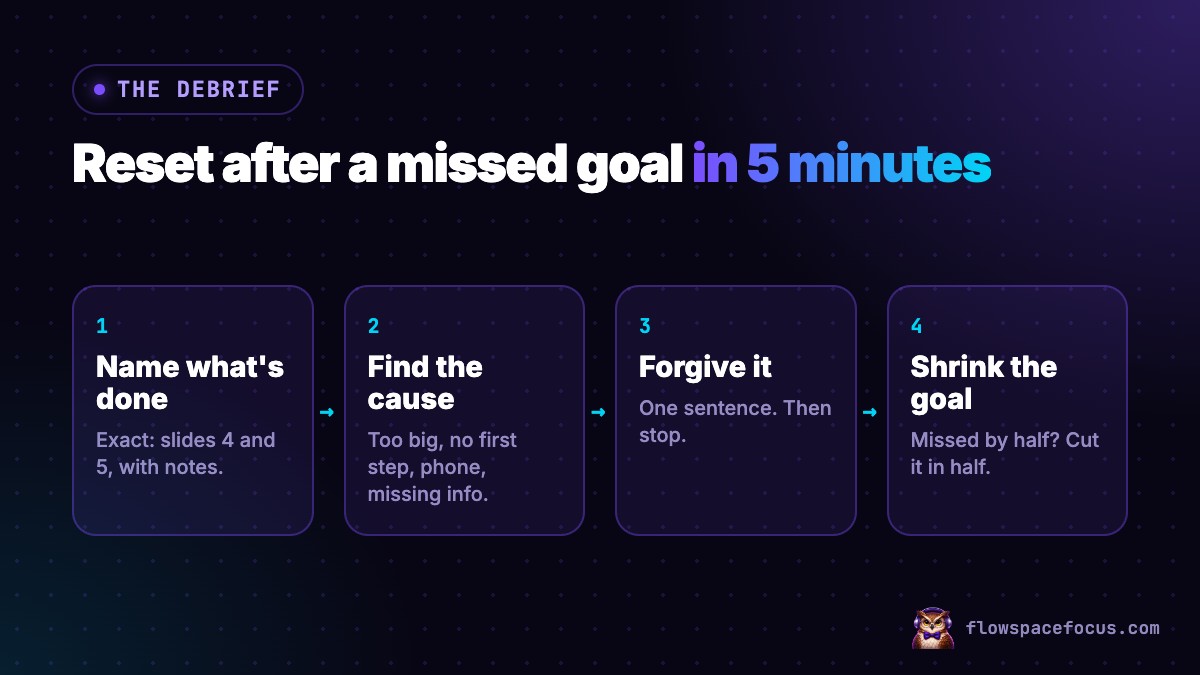
- Name what you did finish. Be exact. "Slides 4 and 5, with notes." Not "basically nothing." You almost always finished something.
- Find the real cause. Use the table below. Pick one.
- Forgive it in one sentence. Write it: "I missed it because the goal was too big. That's fixable." Then stop thinking about it.
- Set the next goal, smaller. If you missed by half, cut the next goal in half.
- Put the next session on the calendar. A time, not "later."
The usual causes, and the fix for each
| What happened | Real cause | Fix for next session |
|---|---|---|
| Ran out of time | Goal too big | Cut the goal in half |
| Spent 10 minutes getting started | No clear first step | Write the first physical action before you start |
| Phone, messages, tabs | Distractions within reach | Phone in another room, one tab only |
| Stuck waiting for information | Missing input | Get the file or answer before the session |
| Reading the same line over and over | Low energy | Move this work to your best hour |
| Didn't know when to stop | No finish line | Add a number: words, pages, problems |
When the same goal misses three times
One miss is noise. Three in a row is a pattern, and patterns are useful.
- Break the goal apart. "Write the literature review" becomes "summarize 3 sources." Here are 12 focus session goal examples to copy.
- Move it to a better time. If it always fails at 9 PM, try it at your best hour. Energy mapping shows you how to find it.
- Check your sense of time. If every task takes longer than you expect, read how data breaks the cycle of time blindness.
- Change the session length. Some work needs 50 or 90 minutes to get going.
How an AI coach handles a missed goal
A coach makes the debrief automatic, which matters most on the days you don't feel like doing it. After every FlowSpaceFocus session, Owliva asks how it went, what you finished and what got in the way. When your attention slips, it doesn't shame you. It asks what happened and helps you get back to work faster.
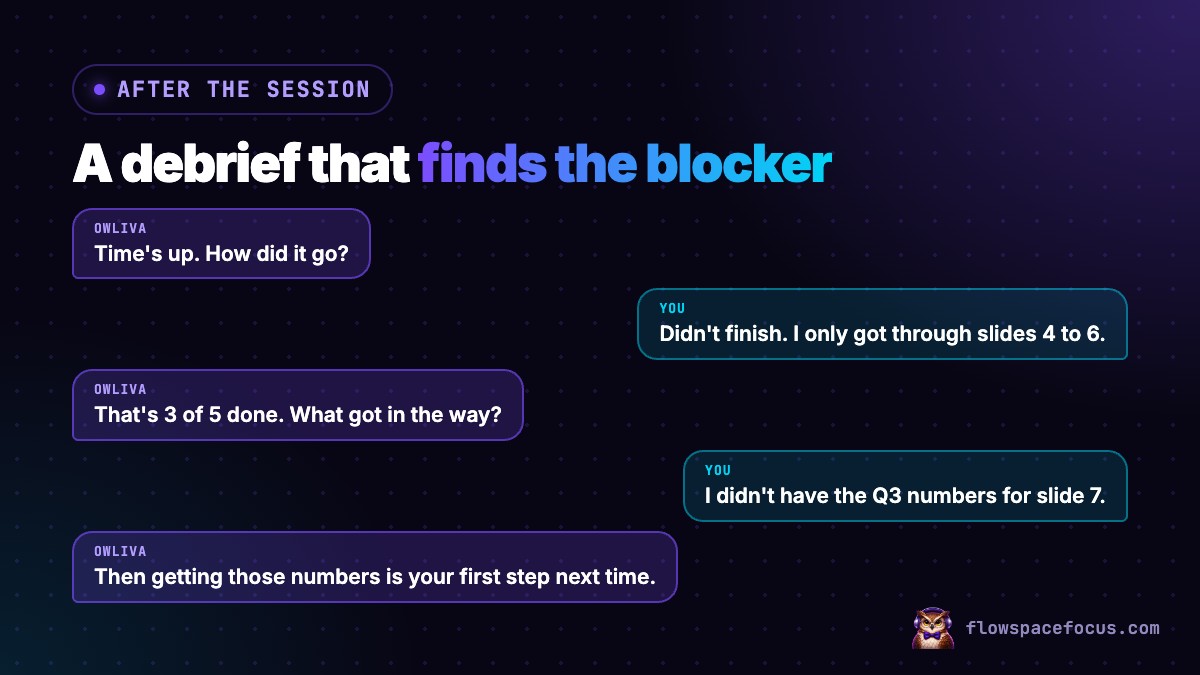
Notice what the example doesn't do: it doesn't ask why you "failed." It finds the blocker and turns it into the next first step. For the longer version of this review, read the 10-minute post-session review.
5 questions after your next missed goal
Answer these in writing. Not in your head.
Question 5 is the one that matters. The fastest way past a missed goal is a finished one.
Quick answers
What should I do right after I miss a goal?
Write down exactly what you did finish, name what got in the way, and set a smaller goal for your next session. It takes five minutes. Skip the replay of everything you did wrong.
Why do I keep missing my goals?
Usually because the goals are too big for the time. People underestimate how long tasks take, even tasks they've done before. If you miss three sessions in a row, cut your goals in half before you blame yourself.
Is it bad to be hard on myself after missing a goal?
It tends to backfire. Research on students found that forgiving yourself for procrastinating was linked to less procrastination on the next exam, and self-compassion after a setback increased the motivation to improve.
When should I change the goal instead of trying again?
When the same goal misses three times. Break it into smaller pieces, move it to a time of day when you focus better, or give it a longer session.
Keep reading
Want a debrief after every session, without the guilt?
See how Owliva's debrief works →