12 Focus Session Goal Examples (and How to Set One Before Every Work Session)
These 12 focus session goal examples turn the vague tasks on your list into goals you can finish before the timer ends. They cover studying, writing, work and admin. Use them as they are, or swap in your own subject and keep the shape.
"Work on the essay" isn't a goal. It's a direction. You sit down, open the doc, read what you wrote yesterday, fix a comma, check your phone, and 25 minutes later the essay looks the same.
If you can't tell when it's done, you can't finish it.
Why vague goals stall
A vague goal gives your brain no place to start and no reason to stop. So it does what's easiest: re-reading, tidying, checking. Goal-setting research has shown this for decades. In Edwin Locke and Gary Latham's review of the field, specific goals led to better performance than "do your best" goals.
A specific goal fixes both problems. The first step is obvious, and so is the finish line. If starting is the part you struggle with most, these task initiation strategies pair well with the goals below.
The 3-part formula for a focus session goal
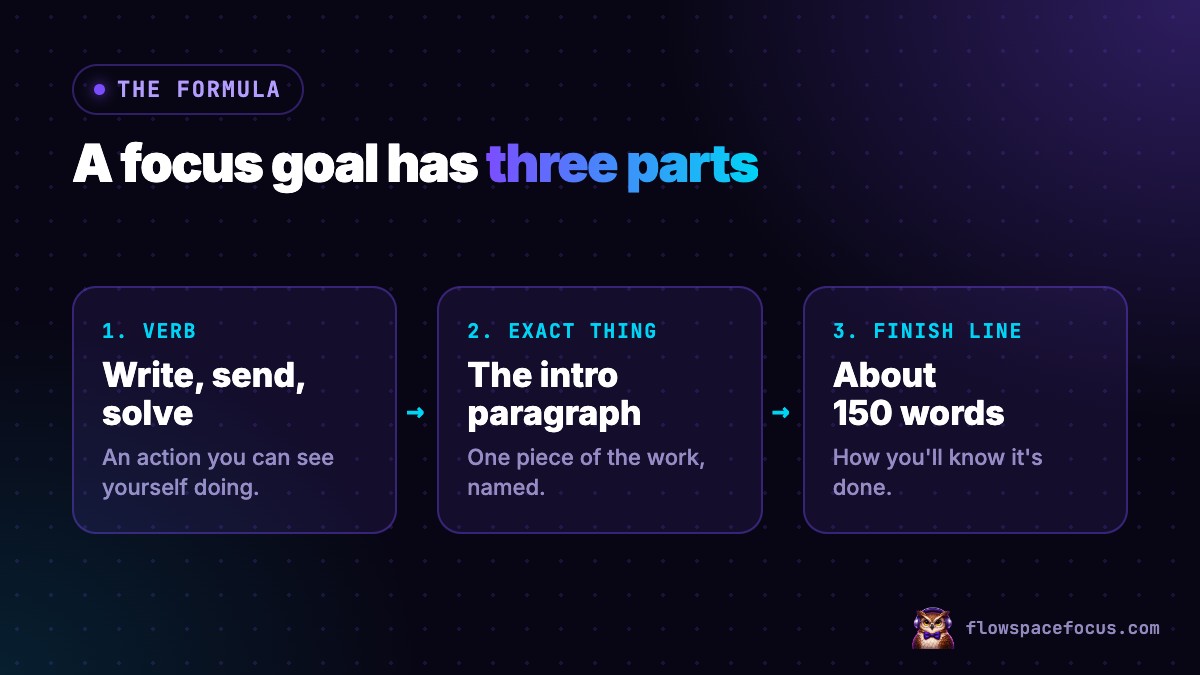
Every goal below follows the same shape:
- A verb. Write, send, solve, read, draft, list. Something you can picture yourself doing.
- The exact thing. Not "the essay." The intro paragraph. Not "email." The 5 flagged emails.
- A finish line. A number, a page, a count. Whatever tells you it's done.
12 focus session goal examples
For studying
| # | Vague | Focus session goal | Fits |
|---|---|---|---|
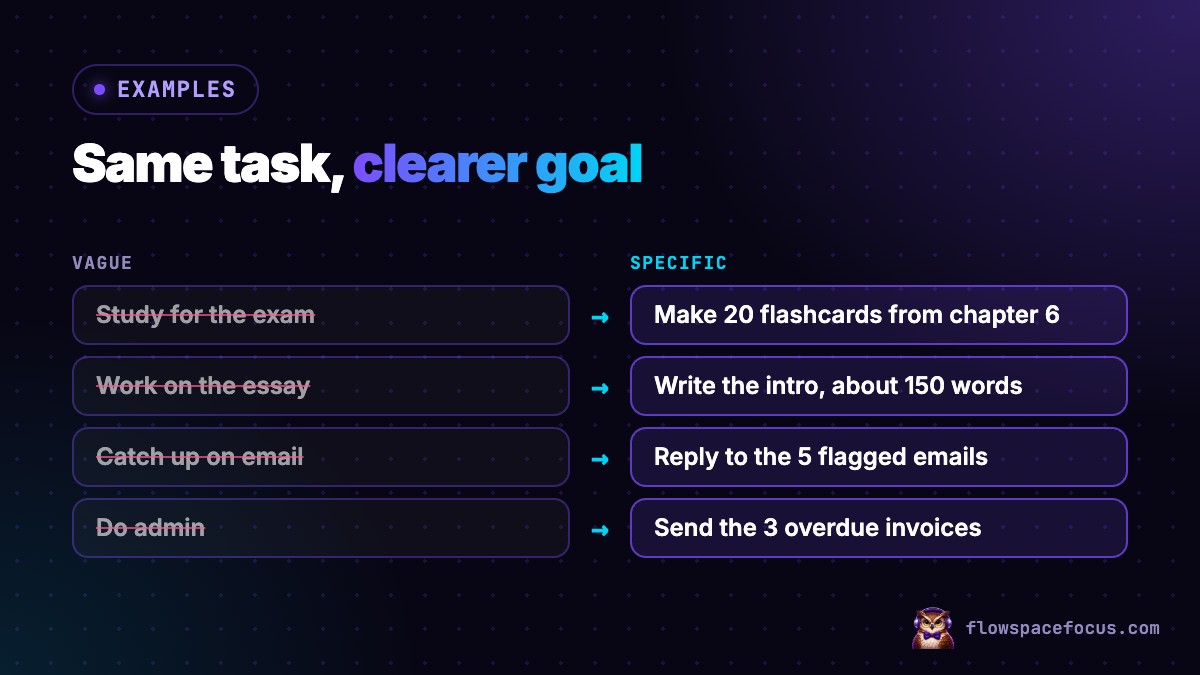
| 1 | Study for the pharmacology exam | Make 20 flashcards for the cardiac drugs in chapter 6 | 25 to 45 min |
| 2 | Read the chapter | Read pages 112 to 130 and write a 5-line summary | 45 min |
| 3 | Practice math | Do problems 1 to 10 on the practice set and check every answer | 45 to 60 min |
For writing
| # | Vague | Focus session goal | Fits |
|---|---|---|---|
| 4 | Work on the essay | Write the intro paragraph, about 150 words | 25 min |
| 5 | Research for the paper | Find 3 peer-reviewed sources and save the citations | 45 min |
| 6 | Edit the report | Cut section 2 down to one page | 30 to 45 min |
For work
| # | Vague | Focus session goal | Fits |
|---|---|---|---|
| 7 | Work on the presentation | Finish slides 4 through 8 with speaker notes | 50 to 60 min |
| 8 | Catch up on email | Reply to the 5 flagged emails, then close the inbox | 25 min |
| 9 | Plan the project | List every task for the launch and give each one a date | 45 min |
For admin and life
| # | Vague | Focus session goal | Fits |
|---|---|---|---|
| 10 | Do admin | Send the 3 overdue invoices | 25 min |
| 11 | Sort out my finances | Categorize last month's transactions | 30 min |
| 12 | Apply for jobs | Tailor my résumé to one posting and submit it | 60 min |
Notice what changed. Every goal on the right has a number or a clear end. You'll know the moment you're done.
How to size a goal to your session length
A good goal fills the session without spilling over. Use this as a starting point:
- 25 minutes (a Classic Pomodoro): one small deliverable. One paragraph, one email batch, one set of flashcards.
- 45 to 50 minutes: one section. A full page, a problem set, a slide group.
- 90 minutes: one chunk of deep work. A first draft of a section, a full chapter read with notes.
- A full workday: don't set one goal for 7 hours. Set one goal per focus block, and pick the next one in each break.
FlowSpaceFocus has seven Focus Flow lengths, from a 25-minute Classic Pomodoro to a 7-Hour Workday. Pick the length after you write the goal, not before.
What to do when the goal turns out too big
It happens. You planned slides 4 through 8 and you're still on slide 5 at the halfway point.
- Shrink it at the halfway check. Slides 4 through 6, done properly, beats 4 through 8 done badly.
- Write down where you stopped. "Slide 6 needs the chart from the Q3 report." Your next session starts there.
- Cut the next goal in half. If you miss three sessions in a row, the goals are too big. That's a sizing problem, not a you problem.
The halfway check is covered in more detail in halfway check-ins that don't break your concentration.
How an AI coach helps you set the goal
Writing a good goal is easy to skip when you're tired. That's where a coach helps. Before every FlowSpaceFocus session, Owliva asks for one specific thing you'll finish, and pushes back if your answer is vague. "Work on my presentation" gets "that's too broad, what exactly will be done?" You start every session with a goal like the ones above, even on the nights you don't feel like writing one.
That's one stage of a three-stage routine. The full method is in our guide to AI accountability for productivity.
5 questions before you set your next goal
Answer these in writing. Not in your head.
Question 5 is the one that matters. A goal you wrote down and started beats a perfect plan for tomorrow.
Quick answers
What is a good goal for a focus session?
One specific piece of work you can finish before the timer ends, with a clear finish line. "Write the intro, about 150 words" is a good goal. "Work on the essay" isn't, because you can't tell when it's done.
How many goals should I set for one session?
One. Two goals turn into a to-do list, and a to-do list turns into switching between tasks. If you finish early, set a new small goal or end the session early.
What if my goal is too big for the session?
Shrink it at the halfway check-in. Finish the part you can, write down where you stopped, and make the rest the goal for your next session. Next time, cut the goal in half before you start.
What's the difference between a task and a focus goal?
A task is the whole job, like "write the research paper." A focus goal is the piece of it you'll finish in this session, like "find 3 peer-reviewed sources and save the citations."
Keep reading
Want a coach that pushes back on vague goals?
Set your first goal with Owliva →