Mid-Session Accountability Check-Ins: How to Stay Accountable Without Breaking Concentration
Mid-session accountability check-ins catch drift while it's still small. Done right, they take 30 seconds and send you straight back to work. Done wrong, they're one more interruption. This guide shows you when to check in, what to ask, and what to do when the answer is "I drifted."
You started well. Twelve minutes in, you're reading about a celebrity's kitchen renovation and you don't remember opening the tab.
Drifting isn't the problem. Staying drifted is.
Why focus slips in the middle of a session
You're not unusual. In a study of 2,250 adults, Harvard researchers Matthew Killingsworth and Daniel Gilbert found that people's minds wandered nearly half the time (46.9% of the moments they sampled), and that people were less happy while their minds wandered.
The middle of a session is the easiest place to lose it. The push of starting has worn off, and the finish line is still far away. That's exactly where a check-in belongs.
Why mid-session accountability check-ins work
A check-in is a small act of progress monitoring. A 2016 meta-analysis in Psychological Bulletin found that monitoring your progress makes you more likely to reach a goal, and the effect was larger when progress was reported to someone or written down. A check-in does that at the moment it's most useful: halfway, while there's still time to fix the session.
Timing is the other half. Drift caught at minute 12 costs you a minute. Drift found at minute 25 costs you the session.
Why most check-ins break concentration
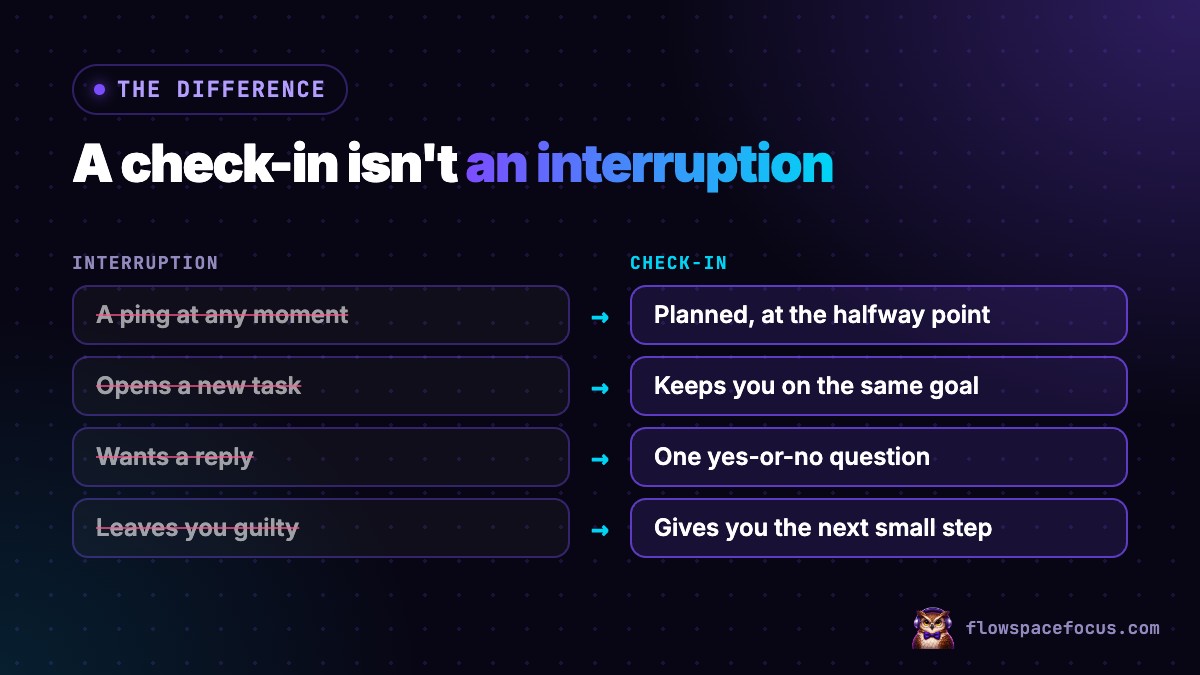
Here's the catch. Researchers at UC Irvine found that people make up for interruptions by working faster, but with more stress and frustration. In another study, interruptions of about three seconds doubled the rate of errors on a task that required keeping track of steps. And when you switch to something else, part of your attention stays behind on it. Management researcher Sophie Leroy calls this attention residue.
So a good check-in follows three rules: it's planned, it's short, and it's about the same task.
How to run a 30-second halfway check-in
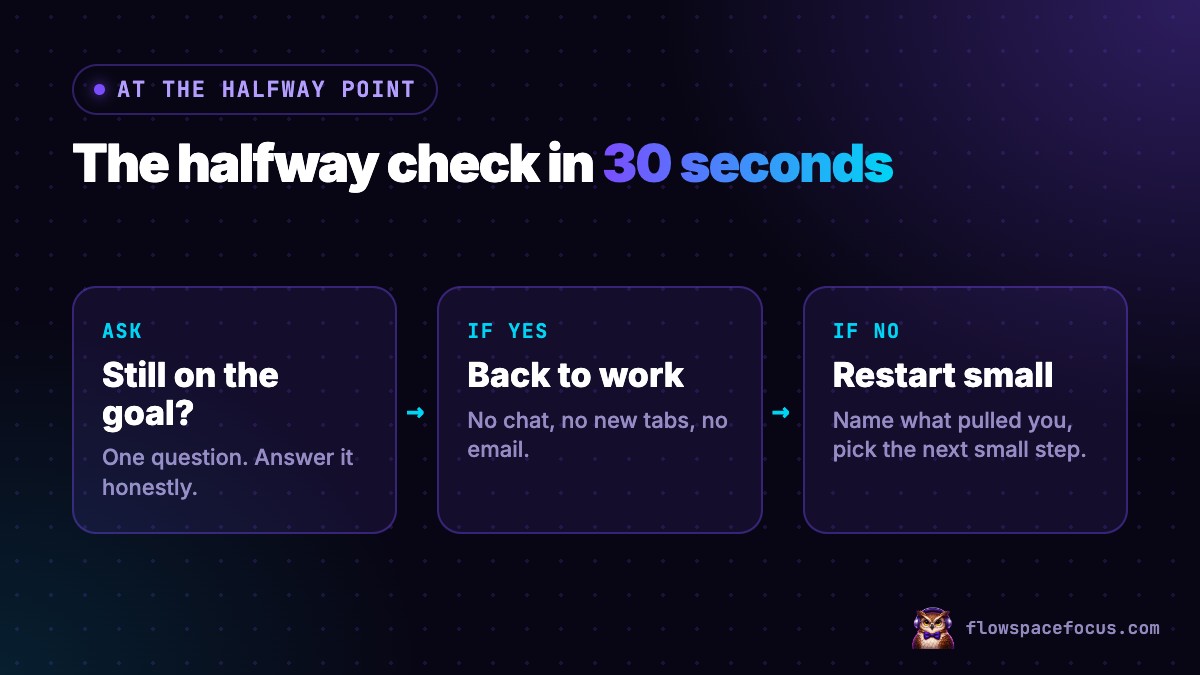
- Ask one question. "Am I still on my one goal?" Not "how's it going?" That invites a story.
- If yes, go straight back. Don't check email "while you're stopped anyway." The stop is the check-in, nothing else.
- If no, name it. One line: "Phone at minute 8." Naming the pull makes it smaller and gives your debrief something real to work with.
- Pick the next small step. Not "get back to the essay." "Reread my last paragraph." Something you can start in under a minute.
- Restart now. Not after one more look at the thing that pulled you.
This is how Owliva's halfway check-in works: a short check that acknowledges your progress and sends you back to work right away.
When to check in
| Session length | When to check in |
|---|---|
| 25 minutes | Once, around minute 12 |
| 45 to 60 minutes | Once, at the halfway point |
| 90 minutes or more | Every 30 minutes |
| A full workday | Once in each focus block, not on a clock all day |
More checks aren't better. Every extra one is a chance to wander off. If you need a check every five minutes to stay on task, the session is too long or the goal is too vague. Shrink one of them. These focus session goal examples help with the second.
What to do when you've drifted
You will drift. Everyone does. What matters is the gap between drifting and coming back.
- Skip the guilt. Guilt feels like taking responsibility, but it's just another distraction. Owliva doesn't shame you when your attention slips. It asks what happened and helps you get back to work faster.
- Plan the comeback in advance. Write an if-then plan before you start: "If I catch myself on my phone, then I'll put it face down and reread my goal." Psychologist Peter Gollwitzer showed that simple if-then plans help people act on their goals at the moment it counts.
- Restart with a two-minute step. Starting again is the hard part, the same as starting the first time. These task initiation strategies work for restarts too.
- Note the pattern. If you drift at the same minute every session, or at the same time of day, that's useful. Use it in your debrief.
Example check-ins
| Situation | What you say | What happens next |
|---|---|---|
| On track | "Paragraph 3 of 5. On track." | Back to paragraph 4. |
| Drifted to your phone | "Phone at minute 8. Restarting at paragraph 2." | Phone face down, reread paragraph 1. |
| Goal too big | "Only halfway through heading 1." | Shrink the goal to headings 1 and 2. |
| Blocked | "Need the lab data, don't have it." | Switch to the part that doesn't need it. |
| Tired | "Rereading the same line." | Finish one small piece, then take the break early. |
Check-ins without an app
No coach? You can still do this:
- Set a second timer for the halfway point, with a quiet sound.
- Write the question on a sticky note: "Still on the goal?" Put it next to your screen.
- Use a person. Message a friend your goal at the start and one line at the halfway point. That's the idea behind body doubling.
- Remove the other interruptions so the check-in is the only one. Here's how to set up a notification-free workday.
5 questions about your next session
Answer these in writing. Not in your head.
Question 5 is the one that matters. One check-in today beats a perfect system next week.
Quick answers
When should I check in during a focus session?
Once, at the halfway point. In a 25-minute session that's around 12 minutes in. Checking in more often turns the check-in into an interruption. For sessions of 90 minutes or longer, a check every half hour works well.
What should a mid-session check-in ask?
One question: am I still on my one goal? If yes, go straight back to work. If no, name what pulled you away and pick the next small step. The whole thing takes about 30 seconds.
Won't a check-in break my concentration?
Not if it's planned, short and about the same task. Interruptions hurt because they pull you onto something else. A check-in that asks about the goal you're already working on sends you back to it.
What if I drift right after the check-in?
Restart with a two-minute step, like rereading your last paragraph or opening the next file. Then note it in your debrief. If it keeps happening at the same point, your sessions are too long for that kind of work.
Keep reading
Want a check-in that sends you straight back to work?
Try Owliva's halfway check-in →