How to Use an AI Accountability Coach During a 25-Minute Focus Session
Here's how to use an AI accountability coach for one 25-minute focus session, minute by minute: what to say before you start, what to do at the halfway check-in, and how to close with a two-minute debrief. Follow it once and you'll know whether coaching works for you.
You opened the app. The coach is ready. Now what? Most people waste their first session chatting, or they ignore the coach and work the way they always do. Both miss the point.
The coach can't do the work. It makes sure you start the right work, and come back to it.
Before you start: set up in two minutes
You need four things, and none of them take long:
- One task. Not your whole to-do list. The one thing that matters most right now.
- A 25-minute timer. That's a Classic Pomodoro, the shortest Focus Flow in FlowSpaceFocus. It's long enough to finish something real and short enough to start on a bad day.
- Your phone out of reach. Face down in another room is best. Out of sight beats on silent.
- Paper and a pen. For every thought that isn't the task. More on that below.
How to use an AI accountability coach, minute by minute
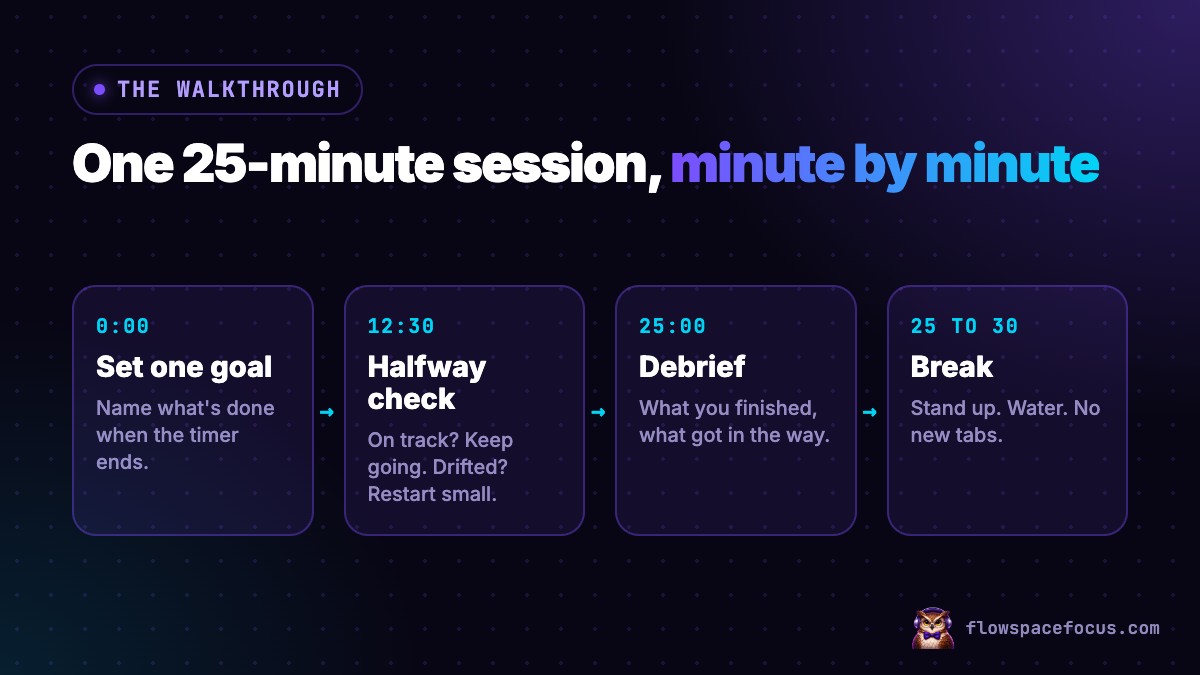
0:00 to 1:00: set one goal
The coach opens with one question: what will you finish? Answer it with three parts: a verb, the exact thing, and a finish line.
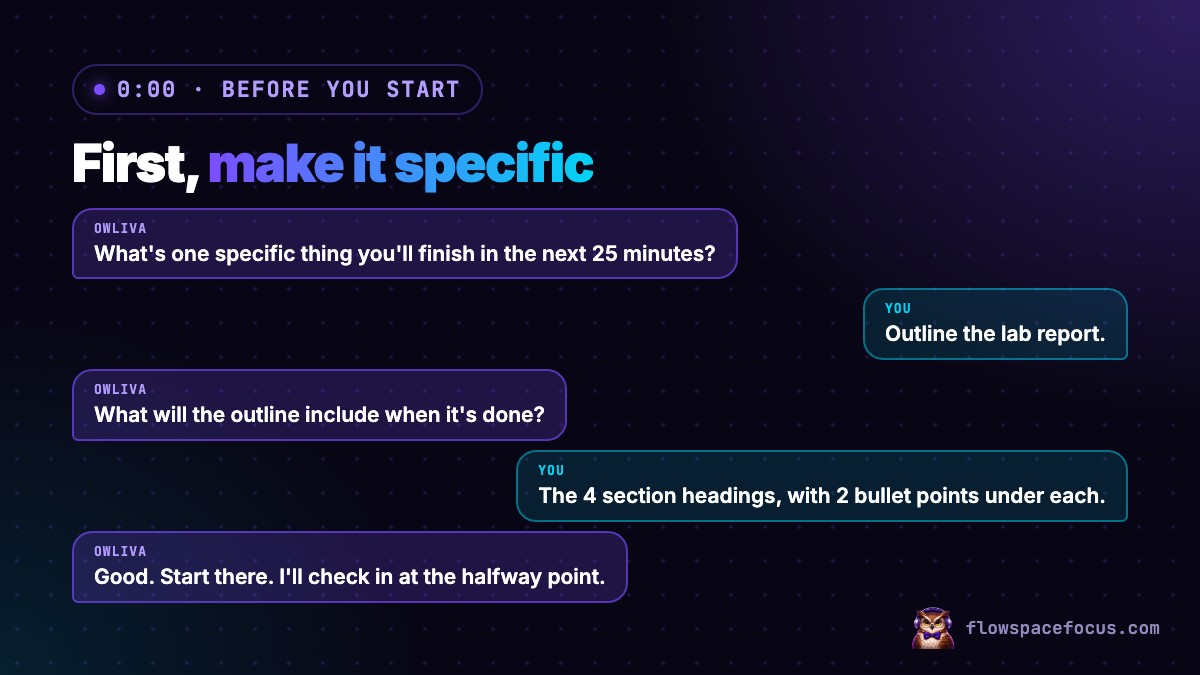
If the coach pushes back, take it. "Outline the lab report" felt clear when you typed it. "The 4 section headings, with 2 bullet points under each" is something you can actually finish, and you'll know when you have. For more goals like this, see 12 focus session goal examples.
1:00 to 12:30: work, and park every other thought
Now the coach goes quiet, and so do you. This stretch is the session.
- One tab, one window. Close everything the goal doesn't need.
- Park, don't act. When "I need to email Sam" pops into your head, write it on the paper and keep going. You'll handle the list after the session.
- Plan for the slip before it happens. Decide now: "If I pick up my phone, I'll put it face down and reread my goal." Psychologist Peter Gollwitzer's work shows these if-then plans help people act on their goals when the moment comes.
12:30: the halfway check-in
At the halfway point, the coach checks in. Keep your answer to one line.
- On track? Say where you are ("on heading 3 of 4") and go straight back to work.
- Drifted? Say what pulled you away and what you'll do next. "Checked my phone at minute 8. Back to heading 2 now." No apology needed. Owliva doesn't shame you for drifting. It asks what happened and helps you get back to work faster.
The check-in takes 30 seconds. Its job is to catch drift while it's small, before it eats the whole session.
12:30 to 25:00: finish, then leave a note
Work until the timer ends. In the last two or three minutes, stop adding and start closing: finish the sentence, save the file, and write one line about where you'd pick up next. That line is the easiest start you'll ever give yourself.
25:00: the two-minute debrief
When the timer ends, Owliva asks how it went, what you finished, and what got in the way. Answer with specifics:
- What did you finish? "Headings 1 to 3 with bullets. Heading 4 has no bullets yet."
- What got in the way? "My phone, once. And I didn't have the lab data open."
- What's the first step next time? "Open the data file, then write the bullets for heading 4."
This is where the session pays off twice. A 2016 meta-analysis in Psychological Bulletin found that monitoring your progress makes you more likely to reach your goals, especially when you write the progress down or report it to someone. The debrief does both.
25:00 to 30:00: take the break
Five minutes. Stand up, drink water, look at something far away. Skip the social feed: it's built to keep you, and five minutes becomes twenty. Then start the next session, or stop for the day knowing exactly where you left off.
What to say to the coach: weak vs. strong answers
| Moment | Weak answer | Strong answer |
|---|---|---|
| Goal (0:00) | "Study." | "Make 20 flashcards from chapter 6." |
| Halfway, on track | "Fine, I guess." | "On card 12 of 20. On track." |
| Halfway, drifted | "I got distracted." | "Phone at minute 8. Back to card 9 now." |
| Debrief: finished | "It went OK." | "Cards 1 to 17. Ran out of time on 18 to 20." |
| Debrief: blocker | "Just tired." | "Didn't have the slides open, lost 4 minutes finding them." |
| Debrief: next step | "Keep going." | "Cards 18 to 20, then quiz myself on all 20." |
Strong answers have numbers and names. They give the coach, and you, something to work with.
Four mistakes that waste a session
- A goal too big for 25 minutes. If you miss it three sessions in a row, cut your goals in half. That's a sizing problem, not a you problem.
- Chatting mid-session. The coach works at three moments. Everything between them is work time.
- Skipping the debrief because you finished. A finished session is the best one to learn from. What made it work?
- Treating a missed goal as failure. It's information. Read the 10-minute post-session review to turn it into a better plan.
After three or four sessions
The Pomodoro Technique pairs short breaks with a longer one, 15 to 30 minutes, after about four sessions. Take it. Then look at your session history. Over a week, FlowSpaceFocus shows when your sessions are strongest, which playlist works best for you, and how your average session length is trending. That's how one 25-minute session turns into a routine. The full method is in our guide to AI accountability for productivity.
5 questions before your first coached session
Answer these in writing. Not in your head.
Question 5 is the one that matters. Put a time on it. Then keep it.
Quick answers
How do I start a session with an AI accountability coach?
Pick one task, set a 25-minute timer, and answer the coach's first question with one specific goal: a verb, the exact thing, and a finish line. "Outline the lab report" becomes "the 4 section headings, with 2 bullet points under each." Then start working.
What should I say at the halfway check-in?
Where you are and whether you're on track, in one line. "On slide 6 of 8, on track" is enough. If you drifted, say what pulled you away and what your next small step is. Then go straight back to work.
Should I talk to the coach while I'm working?
No. The coach works at three moments: before, halfway and after. Between those, the work is the whole job. If a thought pops up, write it on paper and deal with it after the session.
What if I finish my goal early?
Note it in the debrief, because it tells you your goals can be a little bigger. Then either set one small new goal for the minutes left, or end the session and take the break early.
Keep reading
Ready for your first 25 minutes with a coach?
Start a session with Owliva →