AI Study Accountability for College Students: A Weekly Focus Plan That Fits Real Life
AI study accountability for college students is simple: before each study block, a coach asks what you'll finish; halfway through, it checks in; afterward, it asks how it went. This guide turns that into a weekly plan that fits around classes, a job and even night shifts.
In high school, someone noticed when you didn't do the work. In college, nobody's checking. The reading sits there. The exam is three weeks away, until it's three days away.
Nobody's checking. That's the whole problem.
Why studying alone is hard to stick to
College removes most outside structure at once. Deadlines are far away, nobody asks whether you did the reading, and every evening has something more urgent. On top of that, everyone underestimates how long their work will take. Psychologists call it the planning fallacy, and their classic study used students predicting when they'd finish their thesis.
You don't need more willpower. You need a little structure you can't skip.
How AI study accountability for college students works
Every study block gets three short check-ins:
- Before: one specific study goal you can finish in the session.
- Halfway: a 30-second check. Still on it? Back to work. Drifted? Pick the next small step.
- After: what you finished, what got in the way, and what's next.
That's the whole method. The guide to AI accountability for productivity explains why each step works.
Set study goals that actually work
Some study habits feel productive and do very little. In a major review of learning techniques, John Dunlosky and colleagues rated practice testing and spreading study over time as the most useful, and rated rereading and highlighting as low.
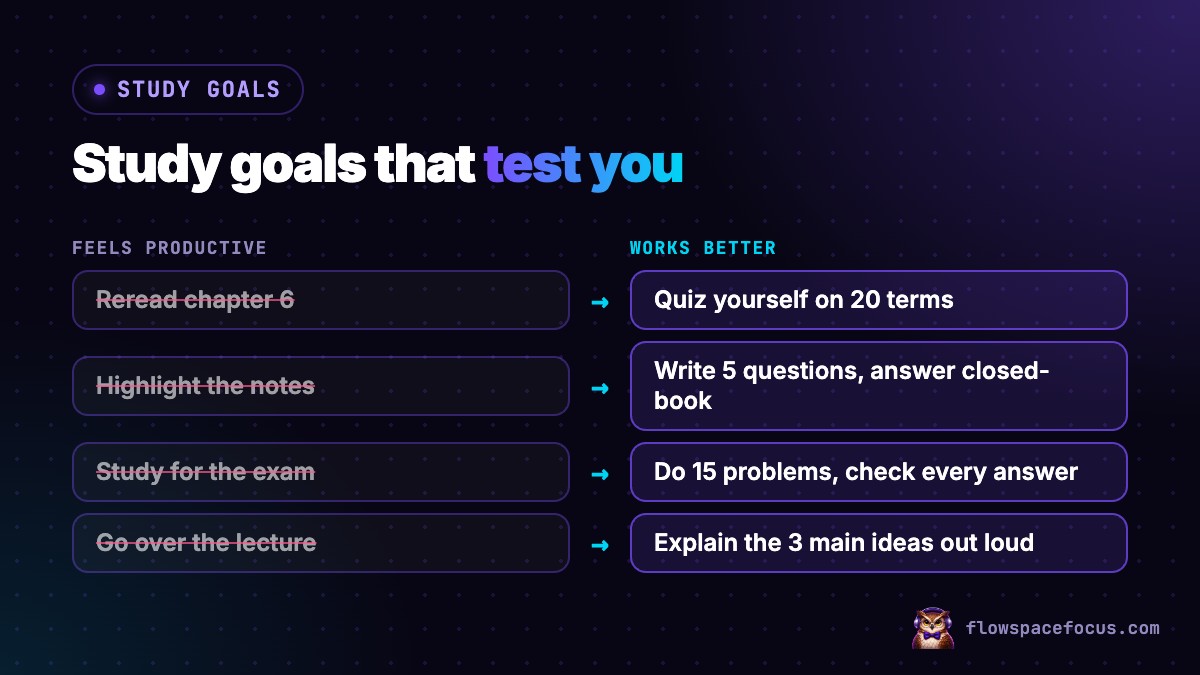
So write study goals that make you test yourself:
| Feels productive | Works better | Session |
|---|---|---|
| Reread chapter 6 | Quiz yourself on 20 terms from chapter 6 | 25 min |
| Highlight the notes | Write 5 questions, answer them closed-book | 25 min |
| Study for the exam | Do 15 practice problems and check every answer | 50 min |
| Go over the lecture | Explain the lecture's 3 main ideas out loud, then check your notes | 25 min |
| Start the essay | Write the thesis statement and 3 topic sentences | 25 min |
For more ready-made goals, see 12 focus session goal examples.
The weekly focus plan
| Day | Plan | Time |
|---|---|---|
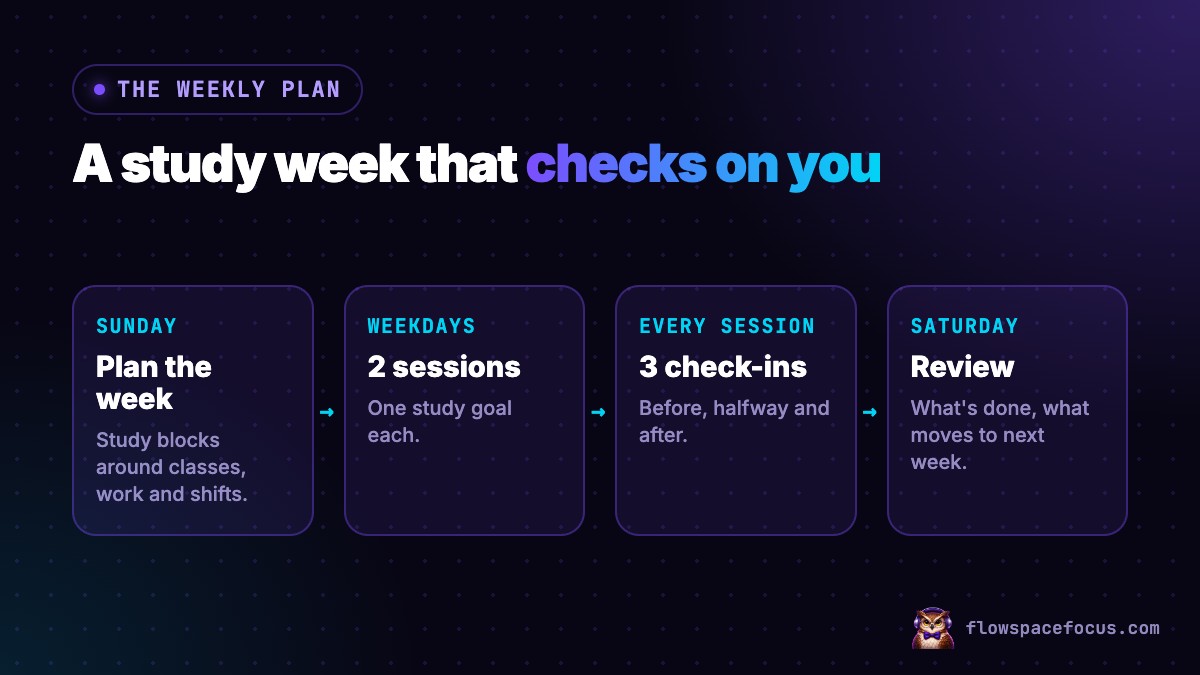
| Sunday | Plan the week: list deadlines and exams, then put study blocks on your calendar around classes, work and shifts | 20 min |
| Normal weekday | 2 focused sessions, each with one goal | 2 x 25 to 50 min |
| Heavy day (labs, long shift) | 1 session, small goal | 1 x 25 min |
| After a night shift | Rest, or one light session (flashcards, a quick review) | 0 to 25 min |
| Saturday | Review: goals finished, what got in the way, what moves to next week | 15 min |
| One day a week | Buffer. Nothing planned. Catch up or rest | Your call |
Spread each subject across the week instead of saving it for one long night. Spacing your study out is the other technique Dunlosky's review rated highest.
Use the halfway check-in for reading and lectures
Reading and lecture review are where minds wander most, because nothing forces an answer. At the halfway point, ask yourself one question: "What are the last three things I read?" If you can't say, you drifted. Go back a page, and switch from reading to quizzing yourself on what you just covered. More in our guide to mid-session check-ins.
Studying around work and shifts
If you work, especially nights, your best hours aren't the same as a full-time student's. Plan for that on Sunday:
- Put hard work in your best hour. Right after a long shift is rarely it. Track a week of sessions and you'll see when yours is. Here's how to focus when the world is asleep.
- Use short sessions on long-shift days. One 25-minute block of flashcards keeps a subject warm.
- Let the coach hold the structure. An AI coach doesn't need a study partner to be awake at 3 AM.
Add a human once a week
AI is there for every session. A person adds stakes. Once a week, study with a friend, join a study group, or try body doubling online. Use both. For options that fit a student budget, see the best AI study accountability apps for students.
5 questions for this week
Answer these in writing. Not in your head.
Question 5 is the one that matters. A plan only counts once it's on the calendar.
Quick answers
How does AI study accountability work?
Before each study block, an AI coach asks what you'll finish. Halfway through, it checks you're still on it. Afterward, it asks what you got done and what got in the way. It adds the structure a class or study group gives you, at any hour.
How many study sessions a day should I plan?
Two focused sessions on a normal day and one on a heavy day is a realistic start. Two 50-minute sessions you actually finish beat a four-hour plan you abandon.
What should a study session goal look like?
Make it an action you can check, ideally one that tests you. "Quiz yourself on 20 terms from chapter 6" beats "reread chapter 6," because practice testing is one of the study techniques with the strongest research support.
Can I use AI accountability if I work shifts?
Yes, and that's where it helps most. An AI coach doesn't need anyone else to be awake. Plan your study blocks around your shifts on Sunday, and keep heavy study off the days right after a night shift.
Keep reading
Want a study partner that's awake when you are?
Start a study session with Owliva →